
Float in CS2 and CS:GO: float checker and real skin float ranges
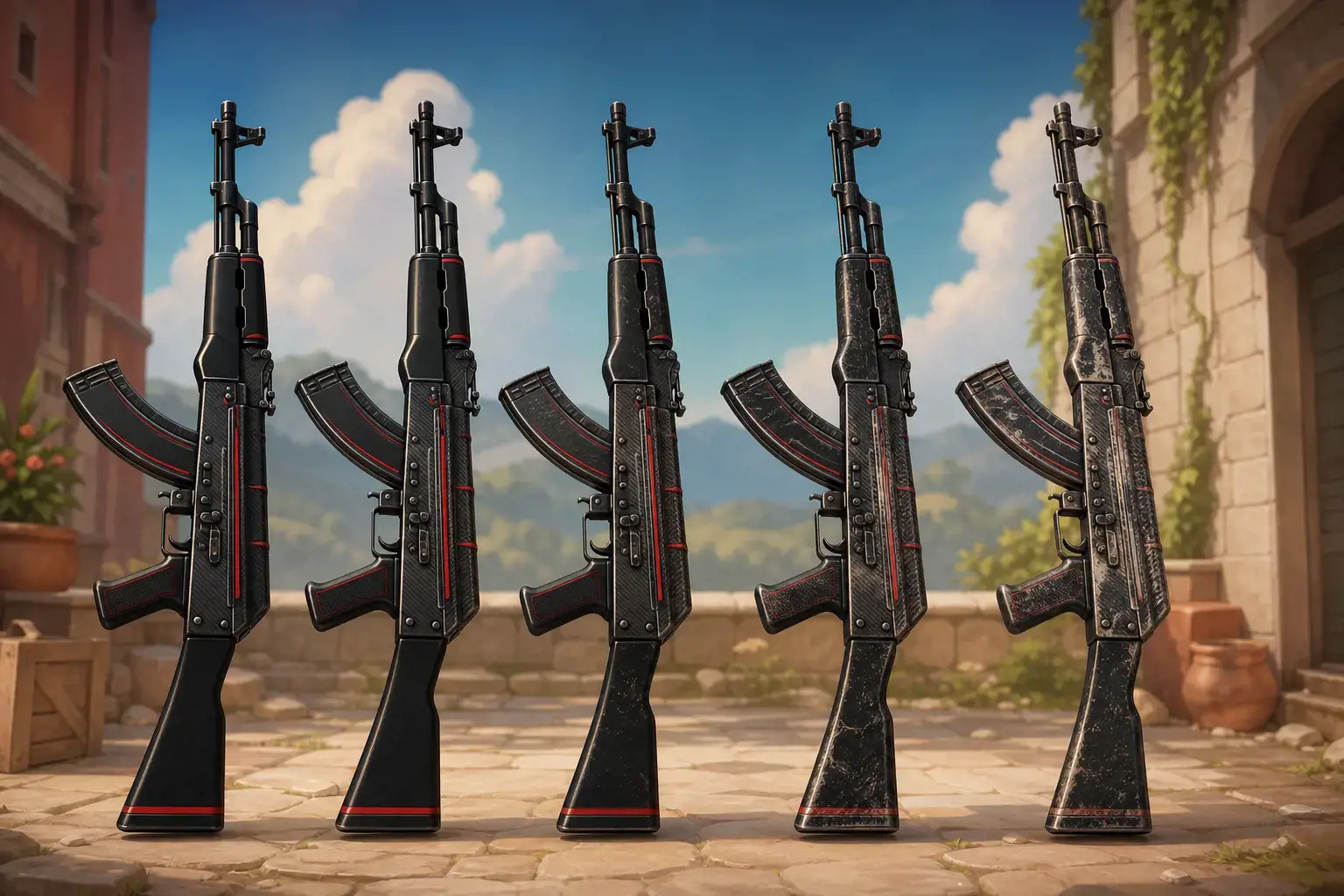
Put two AK-47s side by side wearing the same finish. One looks like it came off the shelf that morning. The other looks like it spent a winter in a shed. Nothing either owner did caused that. It was settled before either rifle existed, by a number called float.
Checker
Which exterior is my float?
That is Field-Tested, the band from 0.15 up to 0.38.
AK-47 Redline can have this float: its range is 0.10 to 0.70.
How this is worked out
- Factory New: 0.00 to 0.07
- Minimal Wear: 0.07 to 0.15
- Field-Tested: 0.15 to 0.38
- Well-Worn: 0.38 to 0.45
- Battle-Scarred: 0.45 to 1.00
Each band starts at its lower figure and stops just below its upper one, so 0.07 is already Minimal Wear.
What is float in CS2?
Float is a decimal, fixed the moment a skin is created, that decides how worn its surface looks. It runs from clean at the low end to scuffed at the high end, and it sorts every skin into one of five named wear bands, Factory New at the clean end through Battle-Scarred at the worn end. It never changes.
The wear bands are decimals, not labels someone picked
The scale is a plain decimal. Lower means a cleaner surface. Higher means more scuffing, more scratches, more of the base metal showing through the paint.
Those decimals are cut into five named bands with fixed boundaries:
Chart
The five wear bands on the 0 to 1 float scale. Factory New covers 0.07 of it, Minimal Wear 0.08, Field-Tested 0.23, Well-Worn 0.07 and Battle-Scarred 0.55.
| Wear band | From | To |
|---|---|---|
| Factory New | 0.00 | 0.07 |
| Minimal Wear | 0.07 | 0.15 |
| Field-Tested | 0.15 | 0.38 |
| Well-Worn | 0.38 | 0.45 |
| Battle-Scarred | 0.45 | 1.00 |
One boundary is worth a note, because the web disagrees about it. You will sometimes see Battle-Scarred given as starting at 0.44. The chart above uses the same band data our own float bar runs on, and it starts at 0.45.
Two things follow from that shape, and both catch people out.
First, the bands are nowhere near the same size. Factory New is a sliver of the scale. Battle-Scarred is over half of it. That is why a skin at 0.45 and a skin at 0.98 carry the same label and look nothing alike.
Second, the bands on offer are a property of the finish, not a universal ladder. The AK-47 Redline has no Factory New band at all. No copy of it has ever existed in one, and none can, because its float range starts at 0.10, above that band. "I will hold out for a Factory New" is not always a plan the finish allows.
Live table
Live, checked today
| Skin | Lowest float | Highest float | Wear bands it can have | Range |
|---|---|---|---|---|
| AK-47 Redline | 0.10 | 0.70 | MW, FT, WW, BS | |
| AK-47 Case Hardened | 0.00 | 1.00 | FN, MW, FT, WW, BS | |
| AK-47 Fire Serpent | 0.06 | 0.76 | FN, MW, FT, WW, BS | |
| AK-47 Vulcan | 0.00 | 0.90 | FN, MW, FT, WW, BS | |
| AK-47 Asiimov | 0.05 | 0.70 | FN, MW, FT, WW, BS | |
| AK-47 Bloodsport | 0.00 | 0.45 | FN, MW, FT, WW | |
| AWP Asiimov | 0.18 | 1.00 | FT, WW, BS | |
| AWP Dragon Lore | 0.00 | 0.70 | FN, MW, FT, WW, BS | |
| AWP Fever Dream | 0.00 | 0.55 | FN, MW, FT, WW, BS | |
| AWP Lightning Strike | 0.00 | 0.08 | FN, MW | |
| M4A4 Howl | 0.00 | 0.40 | FN, MW, FT, WW | |
| M4A4 Asiimov | 0.18 | 1.00 | FT, WW, BS | |
| M4A1-S Printstream | 0.00 | 0.80 | FN, MW, FT, WW, BS | |
| Desert Eagle Blaze | 0.00 | 0.08 | FN, MW | |
| Desert Eagle Golden Koi | 0.00 | 0.12 | FN, MW | |
| Glock-18 Fade | 0.00 | 0.08 | FN, MW | |
| P90 Death by Kitty | 0.08 | 0.32 | MW, FT | |
| USP-S Kill Confirmed | 0.00 | 1.00 | FN, MW, FT, WW, BS |
Float ranges as the game's item data sets them for each finish, the same data our skin pages use. FN, MW, FT, WW and BS are the five wear bands, from Factory New to Battle-Scarred.
Why you still see it called float in CS:GO
Search for this and many of the results say float in CS:GO rather than cs2 float. That is a habit left over from the game's earlier name, not a second mechanic. Older guides say float in CS:GO, newer ones say cs2 float, and people type the question every way there is: what is float cs2, float in csgo, skin float, or just float cs. All of it points at the same field on the same item. The vocabulary is stickier than the branding.
Float and pattern index are two different numbers
This is the correction that matters most, and plenty of explainers get it wrong.
Every skin carries a second number alongside float: a whole number from 0 to 1000 inclusive, also assigned once at creation and fixed for the life of that item. Valve's player-facing name for it is Pattern Template. In the item data it is the attribute set item texture seed. Traders call it the paint seed or the pattern index. Three names, one number.
That number does not touch condition. It decides where the finish's artwork lands on the weapon: which part of the pattern falls on the magazine, which part on the receiver, where a gradient starts and stops.
Picture a long roll of printed fabric, with every shirt in the shop cut from a different spot along it. Where your shirt was cut decides which part of the print you ended up with. That is the pattern index. Separately, the shirt has a finish quality: crisp off the press, or faded and rough. That is the float. Both were settled at the factory, neither changes once the shirt is yours, and knowing one tells you nothing about the other.
So two rifles can share a wear band, share an identical float value, and still look nothing like each other, because the seed put the artwork in completely different places. Float and pattern index are independent axes. Confusing them is the most common mix-up in the whole subject.
Case Hardened: one number decides where the blue lands
 Skin page
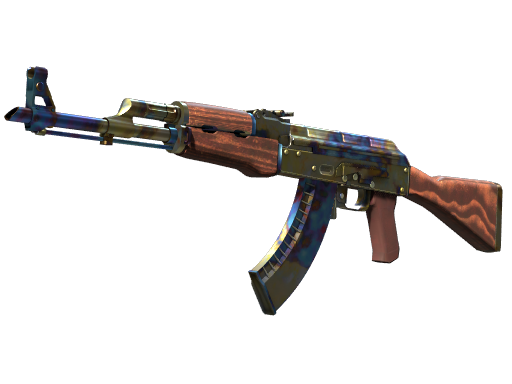
The AK-47 Case Hardened. The pattern seed, not the float, decides how much blue reaches the magazine and the receiver.
The clearest example on any weapon is the AK-47 Case Hardened, one of the launch finishes from 2013. Valve describes it as "color case-hardened through the application of wood charcoal at high temperatures", a real gunsmithing process that leaves mottled, marbled steel. The colors underneath are mostly gold, purple and grey, with patches of blue running through.
The pattern seed decides exactly where those patches fall. A small share of the possible seeds place a large, near-unbroken field of blue across the surfaces a player actually sees, chiefly the magazine and the receiver. Collectors call those copies "blue gems".
Two things to be clear about. "Blue gem" is a community term, not a Valve rating. Valve ranks no patterns at all, on any finish. And it is not a wear judgement: a blue gem can sit in any wear band, because the seed and the float are independent.
Collectors keep lists of individual seed numbers. Seed 661 on the AK-47 is the one named most consistently, sometimes called "the Scar Pattern" for a diagonal gold line crossing an otherwise near-solid blue face. That name grew up around the mechanic in the community; no official designation uses it.
One correction while we are here, because it gets mixed up constantly: the Karambit's famous blue gem is a different seed, 387, on a different weapon. The AK's 661 and the Karambit's 387 are not the same thing and never were.
Fade and Doppler: the same idea, other finishes
Case Hardened is the loudest example, not the only one.
Fade. Valve's own description reads "painted by airbrushing transparent paints that fade together over a chrome base coat". The seed decides how far that gradient travels. A low-numbered pattern keeps the color tight near the muzzle or the tip. A high-numbered one lets it sweep across nearly the whole weapon. Same finish, same possible wear bands, visibly different object.
Doppler. A community-created knife finish introduced with the Chroma Case on 8 January 2015. Every copy is fixed at creation to one of seven named phases: Phase 1, Phase 2, Phase 3, Phase 4, Black Pearl, Ruby and Sapphire. Phase is not wear and not float. It is another property stamped at creation. Emerald is not a Doppler phase, by the way; it belongs to the separate Gamma Doppler finish, which is a common slip.
Three myths to stop repeating
"Float goes up the more you play with the skin." No. Float is set when the item is created and never degrades. Carry a Factory New rifle through a thousand rounds and it does not scuff. The number it was born with is the number it dies with.
"Float and pattern are the same value." No. Float is a decimal and describes condition. Pattern index is a whole number from 0 to 1000 and describes layout. They move independently and they are stored separately.
"Every finish has a Factory New." No. The bands a finish offers depend on its own float range, and some never reach Factory New at all. The AK-47 Redline is the standard example.
What you are actually comparing between two copies
Two copies of the same finish in front of you are two independent readings:
- Condition. The wear band, and the float decimal inside it. Surface scuffing, nothing else.
- Layout. The pattern index. Where the art landed on this specific weapon.
Both live on the individual item, not on the finish as a whole. A pristine copy with an unremarkable seed and a well-worn copy with a striking one are not on the same ladder. They differ in ways that do not rank against each other, and the right question is which axis you personally care about.
If it is condition, read the float, and remember the bands are uneven and that some finishes never offer Factory New. If it is the look, read the seed, and remember that the community's catalogs of specific numbers are exactly that: catalogs players built, not labels Valve issued.
Either way, both numbers were fixed before you ever saw the item, and neither one is going to move.

In short
Float tells you how worn a copy looks, and the pattern index tells you where its art landed. Both are fixed at creation, so read each one on its own.
Reading further: the M4A4 Howl is the one finish Valve stopped producing outright, and the AWP Dragon Lore is the one whose story is mostly about where copies came from.