
M4A4 Howl: the art in your inventory is Valve's own redraw
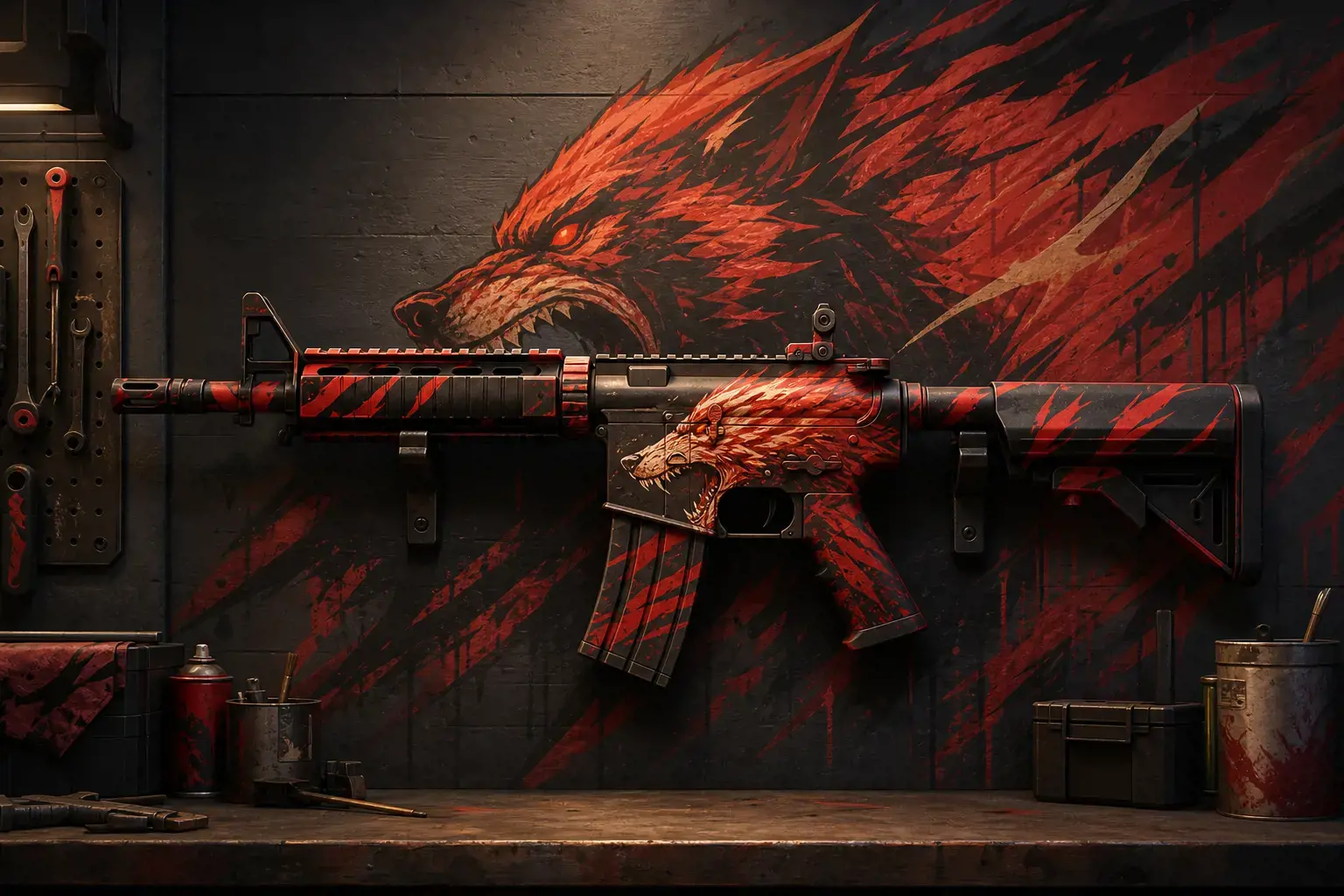
Open your inventory and look at an M4A4 Howl. Valve drew that wolf. It is not the artwork behind the 2014 dispute: Valve replaced the art at the same moment it froze the item's supply, and it said so in writing at the time. Most pages telling this story illustrate it with a picture of the replacement while describing the original.
What is the M4A4 Howl?
The M4A4 Howl is a Counter-Strike rifle finish painted with a snarling wolf. It shipped in the Huntsman Weapon Case on 1 May 2014. Valve pulled it from that case in June 2014, replaced its artwork with its own team's version, and gave it the Contraband grade - the only weapon skin that carries it.
The M4A4 Howl story in three dates
The M4A4 Howl story is usually told with one date. There are three, and the last two get conflated constantly.
- 1 May 2014. The Howl ships in the Huntsman Weapon Case.
- 11 June 2014. A patch on Valve's update blog removes the items.
- 12 June 2014. A Steam Community announcement headed "Respecting Intellectual Property" explains why.
The announcement opens:
"Recently we received a DMCA takedown notice regarding copyright infringement with respect to the M4A4 | Howl, and a community sticker, Howling Dawn, claiming that the artwork was not originally created by the stated contributors. This matter is extremely serious, and we have taken appropriate action to resolve it."
Then the actions, in Valve's words:
"Both contributors have received Steam Community bans. They receive no proceeds from either item, and both items have been removed from the game."
"…those items have been replaced by an alternative designed by the CS:GO team. These items will never be produced again, and have been assigned the 'Contraband' rarity."
That second quote is the one most articles skip, and it is the single most misreported fact about this skin. The wolf in the game today is Valve's own work, made by the CS:GO team to replace the submission the notice concerned.
One phrase in the first quote needs reading slowly. "Removed from the game" describes removal from the case's contents and from production. Copies already sitting in players' inventories stayed valid and stayed tradeable, and they still are. Nothing was deleted out of anyone's account, which is why you can still see one in a loadout today.
What was alleged, and what Valve never said
Valve's wording is precise, and it deserves to be matched exactly. A takedown notice was received, "claiming that the artwork was not originally created by the stated contributors." Valve is describing a claim that arrived at its door. It publishes no finding of its own about who drew what, and it names nobody.
Three things follow, and this is where most retellings run ahead of the evidence:
- Valve names neither submitter. Two handles circulate, in the CS wiki and in a 2016 PC Gamer retrospective. The announcement names neither. Treat them as reported, not as established.
- The original artist's identity rests on a first-person account. The name usually attached comes from the artist's own journal post - not from Valve, and not independently re-verified since.
- No lawsuit appears in the record. A DMCA takedown notice is a request made under a copyright statute, not a court case. Valve documents Steam Community bans and a cut-off of revenue share. No proceeding, no ruling and no settlement appears in any primary document, and no public document describes compensation to anyone.
Valve does use one characterizing word. Its line about revising the case calls them "the copied and discontinued items" - the closest the announcement comes to describing the artwork itself, and still not a published finding about its origin. The honest summary is short. A claim was made, Valve acted on it permanently, and Valve never told the public what it concluded.
What the Contraband grade actually changed
Contraband is not just another color further up the rarity ladder. Valve has applied it to exactly one weapon skin, and the job it does is structural:
- The Howl was pulled from the Huntsman Weapon Case contents. Its old slot belongs to the M4A4 Desert-Strike now, which has had a quieter life.
- It was removed from Trade-Up Contract eligibility, so it cannot be crafted either.
- In Valve's own words, it "will never be produced again".
- Supply is therefore fixed at whatever existed in June 2014, and has not moved since.
No case, no contract, no operation. There is no path by which a new one enters the game. That is a far firmer statement than any adjective about scarcity, and it comes straight from Valve's announcement rather than from a marketplace blog.
Two precision notes, both of which trip up otherwise careful writeups.
It is the only Contraband weapon skin, not the only Contraband item. The Howling Dawn sticker was given the same grade in the same action. "The only Contraband item in the game" is the version you will read most often, and it is slightly off.
The Steam Community Market still tags the Howl "Covert". That is legacy metadata left over from before the reclassification, not a competing claim about the item's grade. It has read that way for over a decade.
Five other skins went the same day, and none of them is Contraband
The June 2014 action was wider than one rifle. Valve also wrote:
"All other in-game items that involve at least one of the contributors in their revenue share have been discontinued."
"The Huntsman Case … has been revised to replace the copied and discontinued items."
Five sibling skins were pulled alongside the Howl, for the same reason and on the same day. The difference is what happened afterwards: those five are still craftable through the Trade-Up Contract. The Howl is not.
That gap is the sharpest available picture of what Contraband singles out. The grade does not mark "this item was caught up in the June 2014 action" - plenty of items were. It marks "this item has no production path of any kind, permanently."
The case carried on without it
The Huntsman Weapon Case is still in the game, and so is the case's AK-47 finish, the Vulcan. The AK-47 Vulcan shipped in the same case on the same day, in the same community collection, and the June 2014 revision left it completely alone. It is sitting in the case's contents right now, entirely unbothered.
That is the contrast to hold onto. The Howl was not singled out for how it looked or how popular it was. The criterion Valve names for the wider sweep is the revenue share behind the item: which contributors were being paid for it. Vulcan came through untouched because neither contributor had a share in it.
Frequently asked questions
Can you still open an M4A4 Howl from a case? No. It was pulled from the Huntsman Weapon Case in June 2014 and has never been returned to that case or added to another one.
Can the Howl be crafted in a Trade-Up Contract? No. It was removed from Trade-Up eligibility in the same action. The five sibling skins pulled the same day can still be crafted, which is the practical difference Contraband makes.
Did Valve delete the Howls people already owned? No. "Removed from the game" covers the case contents and future production. Existing copies stayed in inventories, valid and tradeable, and remain so.
Is the Howl the only Contraband item in Counter-Strike? It is the only Contraband weapon skin. The Howling Dawn sticker carries the same grade from the same June 2014 action.
Why does the Steam Market still call it Covert? Leftover metadata from before the grade was reassigned. Contraband comes from Valve's announcement and the in-game client, not from that tag.
Reading further: the AWP Dragon Lore's souvenir-only history is the other Counter-Strike skin whose story is mostly about distribution rather than art, and what float actually measures explains the wear value that grades a Howl's condition as it does any other finish.